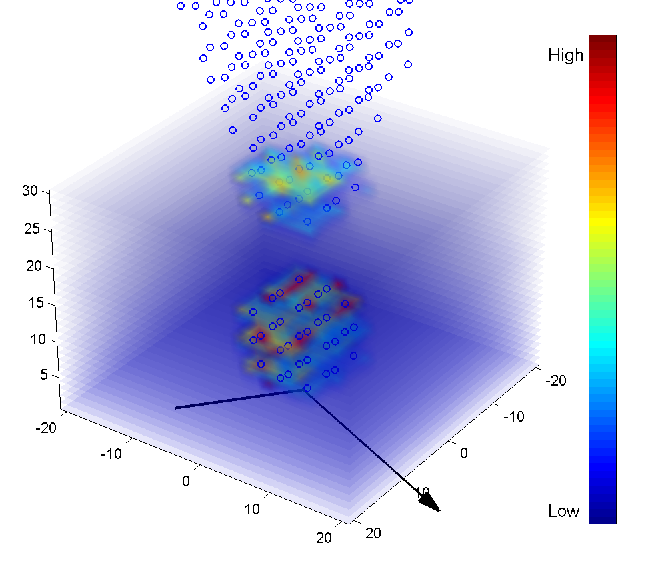
The DDA-SI toolbox for MATLAB:
1) Standard DDA for free space light scattering calculations
2) DDA with surface interaction (DDA-SI)
3) Discrete rotational symmetry-optimized DDA, T-matrix formulation (not include in release v0.1)
Download link for beta releases,
v0.1: http://code.google.com/p/dda-si/
v0.2: https://github.com/dalerxli/dda-si
Functions from the Optical Tweezers Toolbox may be required: https://au.mathworks.com/matlabcentral/fileexchange/73541-ott-optical-tweezers-toolbox
The functions are for coordinate transformation, generating beam shape coefficients for arbitrary illumination, vector spherical wave functions etc.
Please cite the accompanying paper:
Vincent. L.Y. Loke, M. Pinar Mengüç and Timo A. Nieminen, "Discrete dipole approximation with surface interaction: Computational toolbox for MATLAB", JQSRT, Vol. 27 Issue 10, pp.2293-2303 (2010), http://dx.doi.org/10.1016/j.jqsrt.2011.03.012
Associated theoretical paper for reference:
Vincent. L.Y. Loke and M. Pinar Mengüç, "Surface waves and atomic force microscope probe-particle near-field coupling: discrete dipole approximation with surface interaction", JOSA A, Vol. 27 Issue 10, pp.2293-2303 (2010), http://www.opticsinfobase.org/spotlight/summary.cfm?URI=josaa-27-10-2293
Book chapter:
Light, Plasmonics and Particles - Nanophotonics, Chapter 10 - Discrete dipole approximation with surface interaction, https://doi.org/10.1016/B978-0-323-99901-4.00018-4
Corresponding author:
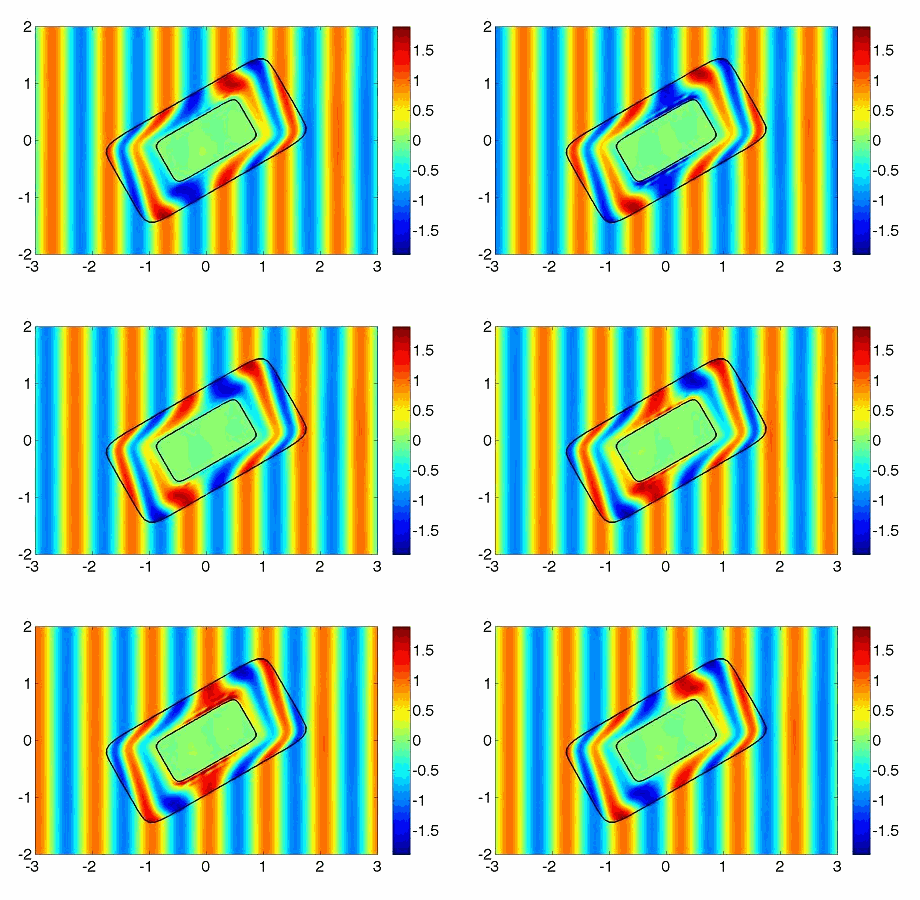
LiteBil is a visualisation tool for ADDA and DDSCAT shape files, developed at the Laboratory of Paper Coating and Converting ( Martti Toivakka) at Åbo Akademi University, Finnland.
- Link (25 Mar 2010) broken (9 Mar 2016)
- Link (19 Apr 2017)
- Local copy (9 Mar 2016)
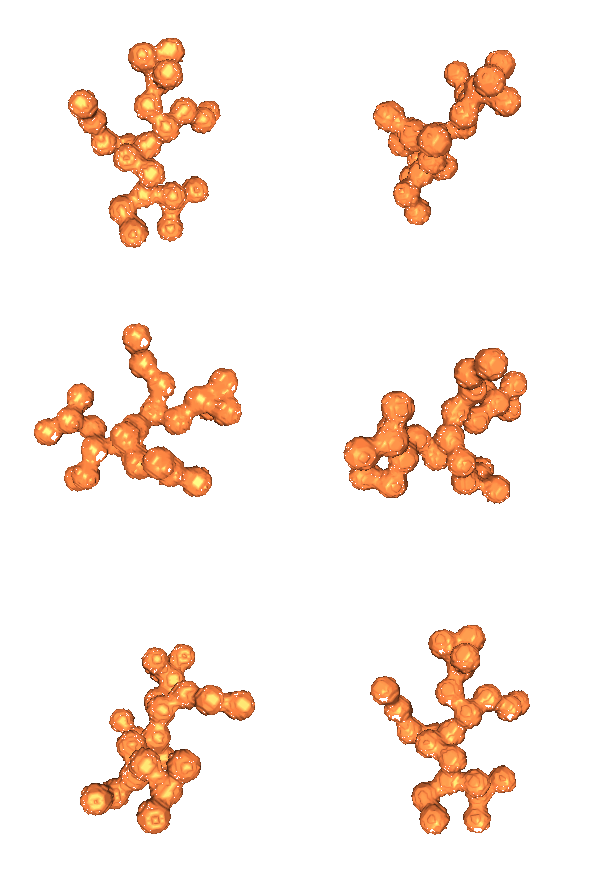
Fortran code based on the Coupled Diple Methode by Shermila Singham. Apparently the sample scatterer comming with the code is a small sphere.
- Link (19 Jun 2009)
OpenDDA by James Mc Donald is a highly optimised computational framework, written in the C language, for the Discrete Dipole Approximation, a numerical method for calculating the optical properties associated with a target of arbitrary geometry that is widely used in atmospheric, astrophysical and industrial simulations.

Matlab CDA (coupled dipole approximation) program for oblate ellipsoids by Matthew David McMahon printed in Matthew David McMahon: Effects of geometrical order on the linear and nonlinear optical properties of metal nanoparticles. Ph.D. Thesis, Vanderbilt University, Nashville, Tennessee 2006.
- Link (25 Feb 2009)
Fortran code solving the volume integral equation printed in Rick Cooper: The effects of a nearby biological body on the parameters of a small hand-held radio operating in the H.F. band (3 MHz-30 MHz), Master of Science Thesis, Ohio University 1992.