Mathematica GLMT
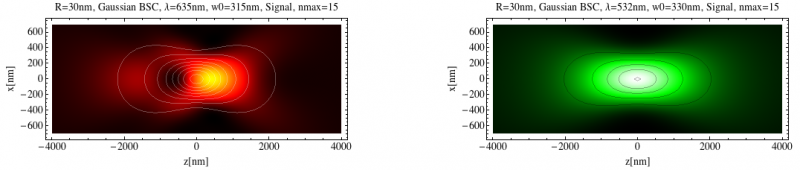
These Mathematica script files by Markus Selmke allow the extensive study of light-particle interaction phenomena enountered in coherent focused beam illumination of spherical (multilayered) scatterers, e.g. to compute the intensity collected by a detection microscope objective and recorded with a photo-diode, radiation pressures, the rel. photothermal signal, sopectra, Poynting vector flows and near fields among other things.
- Link (23 Nov 2011)
pymiecoated
A Python code for computing the scattering properties of single- and dual-layered spheres with an easy-to-use object oriented interface.
Based on code by C. Mätzler; ported and published with permission.
Requires NumPy and SciPy.
- Link (05/11/2012)

EMTL
Electromagnetic Template Library (EMTL) is a free C++ program for electromagnetic simulations. The current version of the program is designed for quick and efficient programming of FDTD simulations and for extending the available FDTD algorithms with new techniques and features.
- Link (18 Oct 2012)
Multiscatter
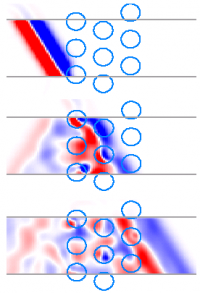
Lidar is affected by multiple scattering in any optically thick medium, particularly liquid clouds. Millimetre-wave radar is typically only affected when observing deep convective clouds from space. One approach to deal with this problem is to use a variational retrieval algorithm with a forward model that can represent multiple scattering while being both accurate and fast. This code is such a forward model, and consists of two algorithms.
- Link (18 Oct 2012)

bhfield
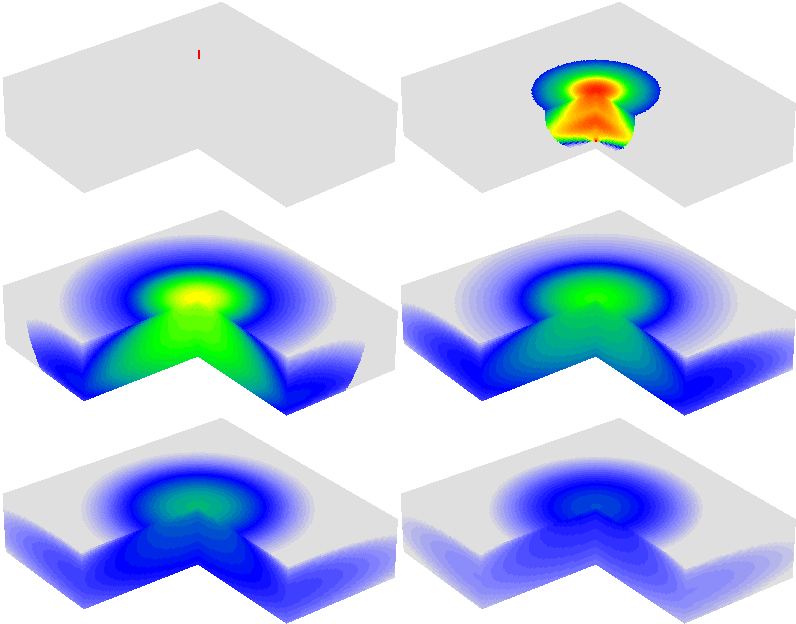
Fortran program bhfield by Honoh Suzuki to compute the nearfield inside and outside of a coated sphere.
H. Suzuki and I-Y. S. Lee: Calculation of the Mie Scattering Field inside and outside a Coated Spherical Particle, Int. J. Phys. Sci., 3, 38-41 (2008; Errata: Int. J. Phys. Sci. 4, 615, 2009).
H. Suzuki and I-Y. S. Lee: Mie Scattering Field inside and near a Coated Sphere: Computation and Biomedical Applications, J. Quant. Spectrosc. Radiat. Transfer, in press (2012).
- Link (2 May 2017)

Metal Nanoparticle simulator MNP
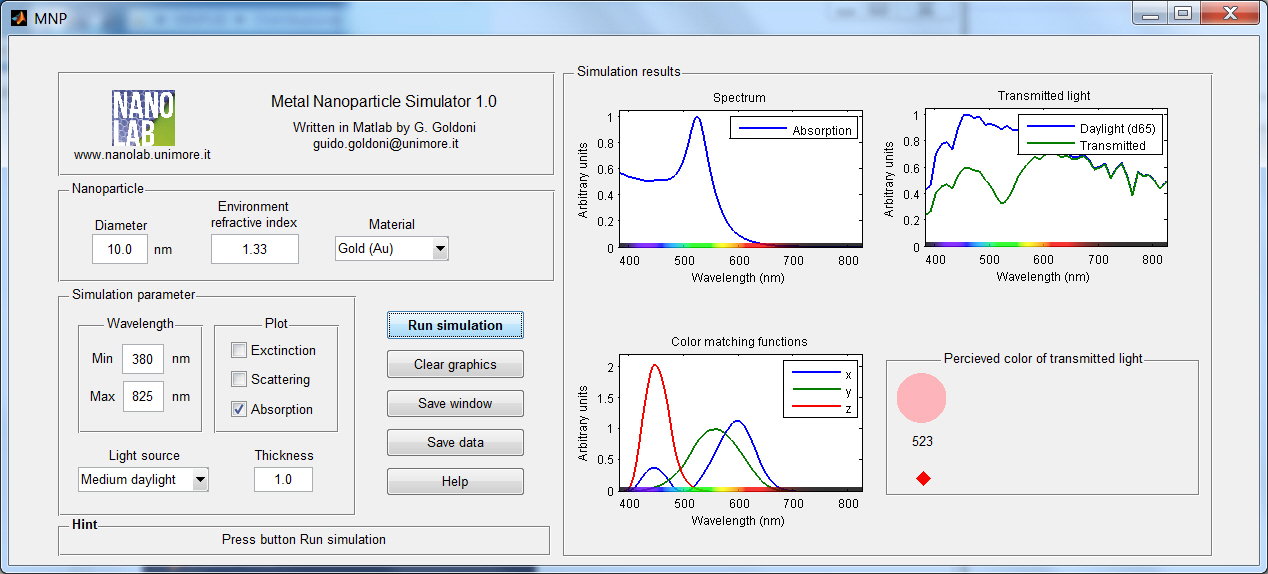
The Metal Nanoparticle (MNP) simulator is a GUI written by Guido Goldoni in Matlab as part of the NANOLAB project (www.nanolab.unimore.it).
MNP allows to simulate the absorption, extinction and scattering spectra of metallic nanoparticles dispersed in a solution. The material and size of the nanoparticles can be changed, as well as the type of solution, to highlight the size dependence of the optical properties of nano-materials, and their possible use, e.g., as sensors.
The MNP GUI uses the Mie theory to simulate spherical nanoparticles. MNP also tries to simulate the color of the solution as perceived by the human eye using colorimetric methods. The perceived color depends on the spectrum of the light source, which can also be changed.
- Link (25 May 2012) local copy
Page 22 of 28